

Ford Trucks That Qualify for Section 179

Commercial InventoryContact Us
The short answer: a Ford you buy for your business gets the fullest Section 179 treatment when three things line up. Its gross vehicle weight rating (GVWR) is over 6,000 lb, you put it in service in the tax year you claim it, and more than half of its use is for the business. Every Super Duty, Chassis Cab, E-Series Cutaway and Transit van on our site that listed a GVWR on November 3, 2026 was well over that line. F-150 GVWR depends on how the truck is built, and SUVs over 6,000 lb carry an extra cap. Your tax professional makes the final call for your business.
Which Ford models qualify (GVWR over 6,000 lb)?
GVWR is the most the vehicle may weigh fully loaded. Ford sets it, and it is printed on the Safety Compliance Certification Label in the driver’s door jamb. It is not curb weight, payload or towing capacity. The table shows the GVWR figures our own new-vehicle listings carried on November 3, 2026, and what decides the rest.
| Ford model | GVWR on our listings (Nov. 3, 2026) | Over 6,000 lb? | What else decides it | See them |
|---|---|---|---|---|
| Super Duty F-250 and F-350 | 10,000 to 12,000 lb | Yes, on every Super Duty that listed one | Bed length. An open bed at least 6 ft long inside keeps a truck out of the SUV cap. | Super Duty |
| Chassis Cab | 14,000 lb (F-350 XL) | Yes | How the finished upfit body is treated. Ask your tax professional before you order the body. | Chassis Cab |
| E-Series Cutaway | 11,500 lb (E-350 SRW) | Yes | Same upfit question as a Chassis Cab. | E-Series Cutaway |
| Transit cargo van | 9,150 lb (T-250, 148 in. wheelbase) | Yes | A cargo van with no seating behind the driver can fall outside the SUV cap. | Transit |
| F-150 | 7,050 to 7,100 lb | Yes, on the F-150s that listed one | GVWR changes with cab, box, drivetrain and payload package, so read the label on the exact truck. A 5.5 ft box is under 6 ft. | F-150 |
| F-150 Lightning | Not listed | Check the door-jamb label | The same F-150 tests: GVWR, box length, business use, in-service date. | Ask us |
| Explorer | Not listed | Depends on the configuration | Over 6,000 lb, the SUV cap applies. At 6,000 lb or less, the passenger-vehicle limits apply. | Explorer |
| Expedition and Expedition MAX | Not listed | Check the door-jamb label | Over 6,000 lb, the SUV cap applies. | Expedition |
| Ranger, Bronco and other models | Not listed | Check the door-jamb label | At 6,000 lb or less, the passenger-vehicle limits apply. Over 6,000 lb, the SUV cap applies unless one of the exceptions below fits. | Ranger | Bronco |
Sources: Internal Revenue Code sections 179(b)(5), 280F(b) and 280F(d)(5); IRS Publication 946, How To Depreciate Property.
The three tests every vehicle has to pass
- Weight. A truck or van with a GVWR of 6,000 lb or less generally counts as a passenger automobile under section 280F, so its first-year write-off is held to the lower yearly depreciation limits.
- Business use over half. Cars and trucks are listed property. Section 179 is open to one only if its qualified business use is more than half in the year it goes into service, and the deduction follows the business share of its cost. A mileage log is the usual proof.
- Placed in service. The deduction belongs to the tax year the vehicle is ready and available for its business job. Signing an order does not place a vehicle in service, so for a business on a calendar tax year, a truck still in transit on December 31 does not count for that year.
Heavy SUVs and the SUV cap
An SUV with a GVWR over 6,000 lb escapes the passenger-auto limits, but section 179(b)(5) caps how much of its cost Section 179 can expense. The rest of its cost is depreciated under the regular rules. The cap does not reach three kinds of vehicles:
- a truck whose open cargo bed is at least 6 ft long inside and cannot be reached directly from the cab;
- a van with seating for more than 9 people behind the driver’s seat;
- a cargo van with no seating behind the driver and no body section more than 30 inches ahead of the leading edge of the windshield.
The dollar figures (the overall Section 179 limit, the phase-out threshold, the SUV cap and the passenger-auto limits) are adjusted for inflation every year, so we don’t print them here. Look them up in IRS Publication 946 for the year you put the vehicle to work, or ask your tax professional.
Questions we hear about specific Fords
Does the Ford F-250 qualify for Section 179?
On weight, yes for the ones we list. Every Super Duty on our site that named its GVWR package on November 3, 2026 showed 10,000 lb or more. With an open bed at least 6 ft long inside, the SUV cap does not apply either. What you can claim still turns on your business use and the date the truck goes to work.
Does the Ford F-150 qualify for Section 179?
The F-150s on our site that listed a GVWR showed 7,050 to 7,100 lb, over the 6,000 lb line. GVWR moves with cab, box, drivetrain and payload package, so read the label on the truck you want. Box length matters too: a 5.5 ft box is under the 6 ft mark, so that truck falls under the SUV cap even when it is heavy enough.
Does the Ford Explorer qualify for Section 179?
It depends on the configuration. If the label on that Explorer shows 6,000 lb or less, the passenger-auto limits apply. If it shows more, the Explorer is treated as a heavy SUV and the SUV cap applies. Ask us for the GVWR of any Explorer on our lot.
Does the Ford F-150 Lightning qualify for Section 179?
The Lightning is an F-150, so it faces the same tests: the GVWR on its label, the length of its box, more than half business use and the date it goes into service. Being electric does not change the Section 179 test.
Does a used Ford qualify?
Yes, Section 179 covers used vehicles as long as they are new to your business. A used Super Duty or F-150 from our lot is judged by the same weight, business-use and in-service rules.
Can you tell me how much I will save?
No. We sell and service Fords; we don’t give tax advice. Your deduction depends on your income, your business use, that year’s limits and the other property you put in service. Take this page to your tax professional; the buyer’s order, the date of sale and the GVWR from the label are the details they usually ask for.
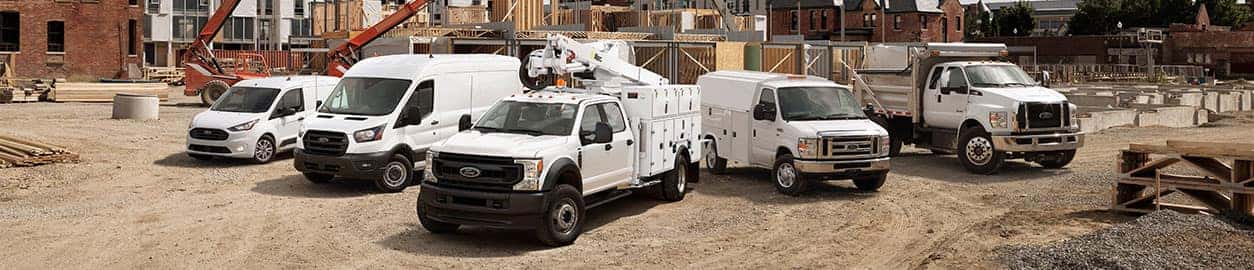
Work trucks and vans at Westlie Ford in Washougal
Start with our commercial inventory, or go straight to Super Duty, F-150, Chassis Cab or Transit. Westlie Ford is at 40 South Marina Way, Washougal, WA 98671. Call (360) 834-2113 and ask which units are on the lot and which are still in transit: only a vehicle you have in service by the end of your tax year (December 31 on a calendar year) counts for that year.
Updated November 2026.
This page is general information from Westlie Ford. It is not tax, legal or accounting advice, and it is not a promise of any tax result. Tax law and the yearly limits change. For the rules that apply to your purchase, see IRS Publication 946 at irs.gov and talk with your tax professional.